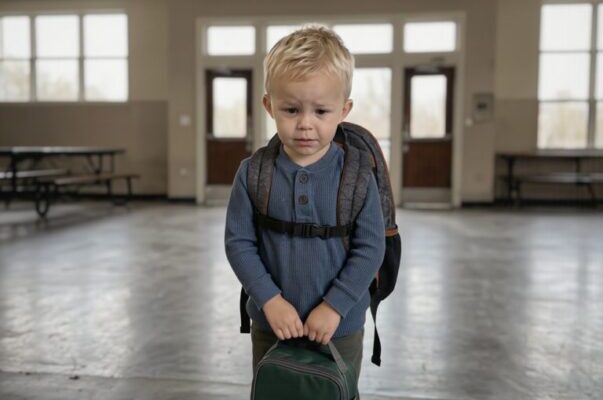
The Empty Lunchbox
When Noah’s teacher called one morning and asked why he kept bringing home an empty lunchbox every day, I immediately assumed another child was taking his food. As a widowed mother struggling to make ends meet, I feared my son was being bullied. What I eventually learned was far more heartbreaking—and far more inspiring—than anything I could have imagined.
Six months had passed since my husband, Daniel, died. Even then, our house still felt heavy with grief. Every morning I woke before sunrise, quietly moving through the kitchen, trying to stretch every dollar as far as possible.
That particular morning, I counted the grocery money I had left: forty-three dollars until payday.
On the counter sat a small lunch for Noah—a simple sandwich, a wrinkled apple, and a handful of crackers wrapped in a napkin. It was not much, but it was all I could manage.
When Noah came into the kitchen, he watched me carefully as I prepared breakfast. Lately, he seemed older than seven. He asked questions children normally do not ask.
“Did you eat yet, Mom?” he said.
“I’ll eat later,” I replied with a smile.
“You said that yesterday.”
I laughed softly and changed the subject, but his concern lingered in my mind.
Before school, we walked together to the bus stop. As the bus approached, Noah hugged his lunchbox tightly.
“Mom,” he asked, “you’ll have lunch today, right? A real one?”
His question surprised me.
“Of course,” I said.
He nodded, but he did not seem fully convinced.
After the bus drove away, I headed home, telling myself that despite our struggles, we would be okay.
About twenty minutes later, my phone rang.
It was Noah’s teacher, Mariella.
“Via, do you have a moment?” she asked gently.
Immediately, I felt nervous.
“Is Noah okay?”
“He’s fine,” she assured me. “But I need to talk to you about something. Can you come to the school?”
When I asked what the issue was, she hesitated.
What happened next is in the first comment 

“It’s about his lunch.”
My stomach tightened.
Teacher Mariella explained that for nearly three weeks, Noah had been returning from lunch with an empty lunchbox every day. At first she assumed he was simply eating everything. But after observing him more closely, she realized something seemed unusual.
She had even offered him free cafeteria meals several times. Each time, Noah politely refused and insisted he was not hungry.
“I think something is happening,” she said. “And I wanted to speak with you before making any assumptions.”
As I drove to the school, my mind raced. I imagined a bully stealing Noah’s food. Perhaps another child was intimidating him. Whatever the explanation, I was determined to find out.
At the school, Teacher Mariella met me and shared her concerns in more detail.
“I don’t believe Noah is eating the lunches,” she said. “I think he may be giving them away.”
The possibility shocked me.
Giving them away? Why?
Noah was a growing child. He needed those meals.
That afternoon, I picked him up after baseball practice. As I watched from the sidelines, I noticed how carefully he ate a small snack another parent had provided. Every bite seemed important.
The sight broke my heart.
When practice ended, we sat together in the car.
“Noah,” I said gently, “I need you to tell me the truth. Is someone taking your lunch?”
His face immediately fell.
“No,” he whispered.
“Then what’s happening?”
For a moment, he stared down at his hands.
Finally, he spoke.
“Am I going to get Eli in trouble?”
“Who’s Eli?”
“He’s my friend.”
Slowly, Noah explained everything.
Eli’s mother had recently lost her job. Many days, Eli arrived at school with no lunch at all. One day Noah found him crying because he was hungry.
“He asked me not to tell anyone,” Noah said. “So I started giving him my lunch.”
Every day for nearly three weeks, Noah had handed over his food to his friend.
My heart sank.
“Why didn’t you tell me?” I asked.
“I knew we didn’t have much money,” he said quietly. “If I told you, you’d pack extra food. That would cost more.”
Then he revealed something that shattered me completely.
Months earlier, he had overheard me crying during a phone call with the bank. He had heard me worrying about bills and wondering how we would survive the month.
Although I thought I had hidden those struggles from him, he had been carrying them with him ever since.
“I didn’t want you to spend more money,” he said. “And I didn’t want Eli to be hungry.”
Tears filled my eyes.
My seven-year-old son had been skipping lunch because he believed he needed to protect both his friend and his mother.
In that moment, I realized there had never been a bully.
The real problem was the burden Noah had silently taken upon himself.
I pulled him into my arms.
“Noah,” I whispered, “I am so proud of your kindness. What you did for Eli was incredibly generous.”
He hugged me tightly.
“But it’s not your job to worry about money,” I continued. “That’s my responsibility. Your job is to be a kid—to eat your lunch, learn, play, and grow.”
“What about Eli?” he asked.
“We’ll help him,” I promised. “But we’ll do it together.”
The following week, I met again with Teacher Mariella.

This time, instead of refusing assistance as I had done for months, I accepted it.
The school connected Eli’s family with meal support and employment resources. They also introduced me to a community program for widowed parents.
Parents, teachers, and community members quietly stepped forward to help. No one judged. No one made anyone feel ashamed. They simply offered support where it was needed.
Gradually, things began to improve.
I found additional bookkeeping clients through the community network. Eli started receiving regular meals at school. Most importantly, Noah no longer felt responsible for carrying burdens that belonged to adults.
A few weeks later, I visited the school during lunchtime. Through the cafeteria window, I saw Noah and Eli sitting together, laughing as they shared crackers and stories.
The bills had not disappeared, and life was still challenging. But for the first time since Daniel’s death, I no longer felt alone.
Standing there, watching my son, I learned a lesson I will never forget.
The proudest moment of motherhood is not providing perfect meals or shielding children from every hardship. It is raising a child whose first instinct is compassion.
And sometimes, the greatest strength is not giving help—it is learning how to accept it.
Noah’s empty lunchbox had seemed like a problem.
Instead, it revealed the extraordinary kindness of a little boy who cared more about someone else’s hunger than his own.