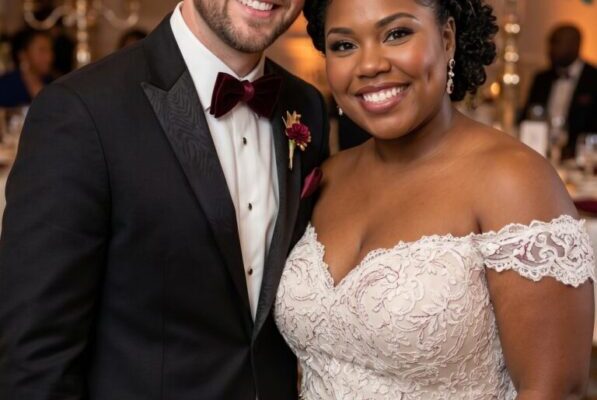
My parents didn’t come to my wedding. They believed my bride couldn’t give them a future. I tried to hold onto the people who did show up, but everything shifted during the reception when my sister discovered two envelopes taped under their empty chairs. In that instant, everything my parents thought they understood came apart.
I met Maya eight years earlier in the waiting room of a tire shop. She stood by the coffee machine, staring at it like it had personally offended her.
“This brown sludge isn’t coffee,” she said.
I almost dropped my keys laughing.
That was Maya.
She named her houseplants after old movie stars, kept color-coded folders for everything, and remembered birthdays of people who barely remembered hers. She was the kind of person who made ordinary life feel softer without even trying.
But to my parents—Sylvia and Desmond—she eventually became something else entirely.
Not a person.
A problem.
They reduced her to one word: endometriosis. A diagnosis they treated like a verdict. They didn’t see her kindness, or the way she showed up with flowers for my mother every birthday even after being insulted, or how she kept trying to bridge a gap that was never her fault to begin with.
To them, she wasn’t someone I loved.
She was someone who couldn’t give them what they wanted most: grandchildren.
And that, in their eyes, was enough to decide everything.
Sunday Dinner
The first time my father said it out loud, we were at Sunday dinner.
Maya had brought lemon bars because my mother liked them.
My father looked at me and said, “Hope you enjoy being the last branch on the tree, son.”
I looked up immediately. “Dad.”
“What?” he said, unfazed. “I’m being realistic.”
My mother set her wineglass down gently. “Daniel, we’re allowed to worry about your future.”
“My future is sitting right beside me.”
“Your future should include children,” she replied. “A family name doesn’t continue on good intentions.”
Maya folded her napkin slowly, aligning every edge with precision. I knew that habit—she did it when she was trying not to fall apart.
“Stop,” I said.
My father leaned back. “We’re talking about family. That’s the most important thing.”
“No,” I said. “You’re talking about my fiancée like she isn’t here.”
Maya stood before I could say anything else.
“Thank you for dinner,” she said quietly. “Dessert is on the counter.”
I pushed my chair back. “Maya, wait—”
She gave me a look I recognized instantly.
Not anger.
Exhaustion.
“I’ll wait in the car.”
I followed her outside.
“I should’ve stopped them,” I said.
“Trying isn’t the same as stopping,” she replied.
She wrapped her arms around herself, looking away. “I don’t need you to win every fight. I need you to stop bringing me into rooms where I have to prove I’m human.”
That landed like a blow I didn’t see coming.
“You can love people,” she added softly, “and still stop handing them knives.”
The Years That Followed
Even after that night, Maya kept trying.
She sent birthday gifts to my mother.
She wrote thank-you notes after family dinners.
She asked about my father’s knee surgery like it mattered.
My parents accepted her kindness without ever returning it. It became expected. Never appreciated.
Then came the IVF years.
Four rounds.
Two early losses.
Medical bills stacked like evidence of hope that kept collapsing under its own weight.
After the second loss, I found Maya crying alone in a clinic bathroom.
“I’m tired,” she whispered. “Tired of hoping and burying it quietly.”
We kept going anyway.
Until Dr. Patel.
For the first time, someone looked at Maya without dismissing her pain.
“Pain that changes your life doesn’t need to be proven,” Dr. Patel said.
Maya broke before she even finished listening.
Her prognosis was uncertain, her chances low, and for the first time she stopped pretending she could carry grief and optimism in the same hand.
Outside, she closed her folder and said, “I don’t need to organize grief.”
That was when we stopped building our future around what might never happen.
And started planning a wedding instead.
The Ultimatum
Discover the rest in the first comment 👇👇

Two weeks before the wedding, my mother called.
“Daniel, don’t make us watch you throw your life away.”
“You’re talking about my fiancée,” I said.
“She cannot give you children.”
“Maya is my family.”
“If you marry her, we won’t be there.”
There it was.
Final, clean, and unconditional.
So I answered the only way I could.
“Then there will be two empty chairs.”
And I hung up.
The Bridal Shower
My mother didn’t come to the bridal shower.
She sent a gift instead.
Inside the card, Emily showed me a message:
For the home you’ll have, even if it’s never filled with children.
Maya read it before I could stop her.
She didn’t cry. She just kept tying ribbons like her hands could outrun what she felt.
“We’re not leaving,” she said.
“We should.”
“No,” she replied. “They don’t get to be the only story.”
The Wedding Morning
On the morning of the wedding, my mother texted: Do not contact us until you come to your senses.
That was when it finally clicked.
I wasn’t just angry.
I had been waiting.
Waiting for approval that was never coming.
Maya stepped into the room in her wedding dress and saw my face immediately.
“They’re not coming,” she said.
I handed her my phone.
She read it, then set it down gently.
“Are you still choosing me?” she asked.
“Always.”
“Then stand up.”
So I did.
The Empty Chairs
Two chairs stayed empty at the ceremony.
Two names remained on the seating chart that would never be fulfilled.
But the room wasn’t empty.
Emily was there crying in the front row. My aunt held a tissue to her face. Maya’s friends filled the space with warmth that didn’t need permission.
For the first time, I stopped looking at who was missing.
And started noticing who stayed.
The Reception Surprise
During the reception, Maya asked everyone to check under their chairs.
Inside each envelope was a handwritten note:
Thank you for showing up. Family isn’t just who shares your name—it’s who takes a seat when it matters.
Then Emily found the envelopes under my parents’ chairs.
“Grandma. Grandpa.”
Inside was a sonogram.
Three months.
Maya was pregnant.
The room went still in a way that felt like the air itself had stopped moving.
“We wanted this moment to be joy,” she said softly. “But only with people who chose us.”
The Call
Emily showed my parents the sonogram over video.
At first, disbelief. Then urgency. Then desperation.
“We’re coming,” my mother said immediately.
But Maya shook her head.
“You missed the wedding,” she said. “You missed me becoming his wife. You don’t get to skip those moments and claim the next one.”
And just like that, the door closed.
The Final Step
Later that night, they arrived at the venue.
We stepped outside together.
My mother reached for me.
I stepped back.
“You’re not coming in.”
“We’re your parents.”
“Not tonight.”
She turned to Maya. “We’re sorry.”
Maya nodded slowly.
“I hope one day you mean that,” she said. “Not for the baby. For me.”
The Last Dance
At the end of the night, Maya rested against me as we danced.
The envelopes meant for “Grandma” and “Grandpa” were placed into her keepsake box—not as titles earned, but as reminders of what had been offered and rejected.
I looked through the glass doors one last time.
My parents stood outside.
Still hoping the door would open.
But it didn’t.
And for the first time, I didn’t try to open it either.