I was twenty-two years old, exhausted, and constantly running out of time.
By day, I went to college classes. By night, I worked at a grocery store stocking shelves until my hands went numb. Every spare moment in between was spent helping my mom take care of my younger brother, Noah.
Noah was fourteen, but hospitals were more familiar to him than school hallways. His condition required constant treatment—treatments that cost far more than anything my family could afford.
My mother never complained. She worked double shifts as a nurse’s aide and still managed to smile for Noah when fear crept into his eyes. But I could see what she tried to hide. The stack of unpaid bills on the kitchen table. The way she sat alone at night when she thought no one was watching. The quiet collapse behind her eyes.
Then one rainy Thursday, another hospital bill arrived.
She stared at it for a long time, folded it carefully, and placed it with the others. But this time, something in her expression didn’t recover afterward. It was the first time I saw what looked like surrender.
That night, I couldn’t sleep.
I opened my laptop and searched for anything—dog walking, tutoring, cleaning jobs, anything that might help. That’s when I saw it.
“Seeking young woman, approximately age 20–25, to spend Sundays with elderly blind veteran. Compensation generous. Must be comfortable acting as family companion.”
It sounded strange. Almost wrong. But the pay was more than I made in a week.
The listing explained that the man’s granddaughter no longer visited. They wanted someone to keep him company, to give him a sense of family in his final years.
I nearly closed the tab.
Then I looked at the hospital bill beside me.
And I applied.
A week later, I met the woman who arranged everything. Her name was Linda. She looked tired in a way that suggested it had nothing to do with sleep.
“My father lost his sight six years ago,” she said. “He’s stubborn. Proud. And very lonely, even if he refuses to admit it.”
She hesitated before continuing.
“My daughter stopped visiting after a family disagreement. He still asks about her.”
Then she looked at me directly.
“I don’t want him to spend what time he has left feeling abandoned.”
My voice felt distant when I asked, “What exactly do I have to do?”
“Just visit on Sundays. Talk to him. Eat lunch with him. Keep him company.”
What happened next is in the first comment 

“And pretend to be his granddaughter?”
A pause.
“Yes.”
It should have been simple to refuse.
But I agreed.
The first Sunday, I was nervous the entire drive.
Walter Harrison lived in a quiet house surrounded by old oak trees and overgrown flowers. When I knocked, he opened the door almost immediately.
Even though he couldn’t see me, he smiled.
“There you are,” he said.
Something in my chest tightened.
“Hi… Grandpa.”
The word felt unnatural on my tongue.
He reached out, found my hand with surprising certainty, and guided me inside.
That first visit lasted hours.
Walter talked most of the time—about military service, repairing engines, fishing trips, and a life that seemed too large for the small house he now lived in. When he spoke of his late wife, Margaret, his voice softened in a way that made the room feel warmer.
“She could make anyone laugh,” he said quietly. “Even me.”
I found myself listening more than acting. And somewhere along the way, the performance stopped feeling like a performance.
Sunday became a rhythm.
Weeks passed, then months.
Walter stopped feeling like a task I was paid to complete. He became someone I looked forward to seeing. He remembered details about my life—my exams, Noah’s treatments, my mother’s exhaustion. He asked questions no one else asked.
One afternoon he said, “How’s your brother doing?”
I froze.
I had never told him Noah wasn’t actually his great-grandson.
Then I remembered—I had told him. Everything. Somewhere between truth and pretending, I had stopped separating the two.
“He’s having a rough week,” I admitted.
Walter squeezed my hand.
“He’s lucky to have you.”
That sentence stayed with me longer than I expected.
Eventually, I stopped thinking of Sundays as work. I visited even when I wasn’t scheduled. I brought cookies. I stayed longer than I needed to. I listened.
The arrangement had started as a lie.
But the connection wasn’t.
Somewhere in the middle of it all, it became real.
One Sunday, I arrived and immediately knew something was wrong.
Walter’s voice was weaker. His breathing slower. His hands trembled when he reached for his cup.
“You alright?” I asked.
He gave a small laugh. “Getting old isn’t for cowards.”
But neither of us laughed long.
Over the following months, his health declined. Hospital visits increased. Walking became difficult, then impossible. Still, he insisted on our Sundays.
One afternoon, I adjusted his blanket, and he reached for my hand.
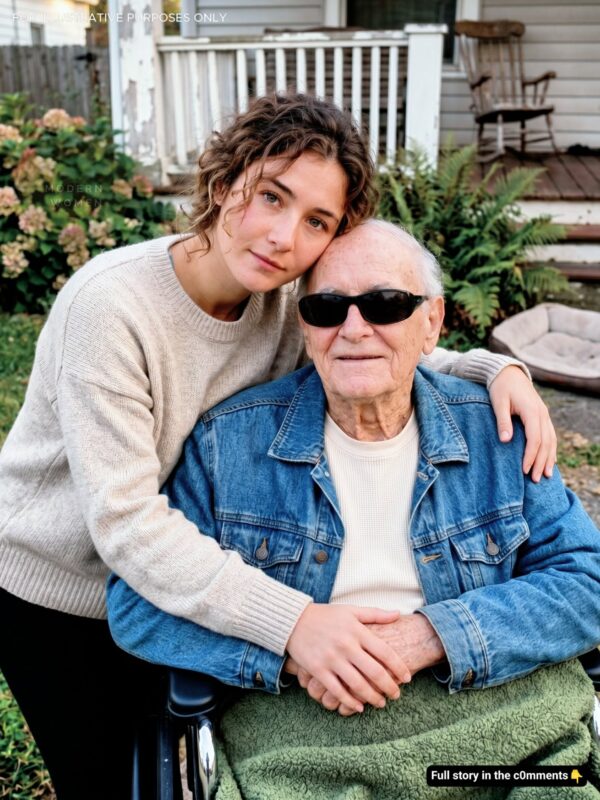
“You know something?” he said.
“What?”
“You changed my final years.”
My throat tightened.
“No,” I whispered. “You changed mine.”
He smiled, as if that answer made sense either way.
Three weeks later, Linda called.
“I’m sorry,” she said quietly.
And I knew before she said anything else.
He was gone.
The world felt unusually silent after that. I didn’t cry right away. I just sat there, trying to process the absence of someone who had become part of my life without permission from time or logic.
The funeral was full—veterans, neighbors, old friends. I sat in the back and listened to stories that all sounded like the man I knew: kind, stubborn, generous, loyal.
Afterward, Linda hugged me tightly.
“He adored you,” she said.
I couldn’t respond.
A week later, a call came from an attorney.
“There’s a matter regarding Mr. Harrison’s estate,” he said.
My first instinct was denial.
“I think you have the wrong person.”
“I don’t.”
At the lawyer’s office, I noticed the way people looked at me—confused, suspicious, judgmental. Whispers followed as I entered the room.
“The girl.”
“The fake granddaughter.”
I kept my eyes down.
Attorney Whitaker opened a folder.
“Before his passing, Walter Harrison left specific instructions regarding Miss Emily Carter.”
My breath stopped.
He began reading.
“To my family. You may be surprised to see Emily here today. Many of you know she was not my biological granddaughter. But I knew this from the beginning.”
The room shifted.
Gasps. Murmurs. Stunned silence.
I looked up, heart racing.
Walter knew.
The attorney continued.
“I recognized a different voice. Different steps. Different presence. I knew.”
My vision blurred.
“He was never deceived,” the letter went on. “At first, I allowed it because I was lonely. But over time, something changed. Emily stopped pretending. She became herself. And that person brought more kindness into my life than I expected to ever receive again.”
Silence filled the room.
“Many people share your blood. Very few share your heart. Emily stayed not because she was paid, but because she cared.”
My hands were shaking.
Then the final instruction:
“I request that a portion of my estate be placed into a trust for Noah Carter’s medical care and education. No child should suffer due to financial hardship.”
The attorney paused.
“Two hundred thousand dollars.”
I stopped breathing.
It felt unreal. Not just the amount—but the thought behind it. A life being redirected by someone who had every reason not to care.
Then another envelope.
Handwritten.
Emily,
If you are reading this, I’ve likely gone off somewhere arguing with angels.
Thank you—for every Sunday, every conversation, every moment you treated me like I still mattered.
Family isn’t always who we’re born to.
It’s who stays.
You stayed.
That makes you my granddaughter in every way that matters.
—Grandpa Walter
By the time I finished reading, I wasn’t the only one crying.
Years have passed since then.
Noah is healthy now.
My mother works normal hours.
I graduated college.
But every Sunday, I still visit Walter’s house.
Linda keeps the door unlocked.
I sit in his chair and tell him about my week, my family, the ordinary things that used to feel impossible.
And sometimes, when the wind moves through the trees, I imagine I hear his voice again.
“How’s your brother doing?”
I always smile when I answer.
“He’s doing great, Grandpa.”
And somehow, it still feels like he hears me.